
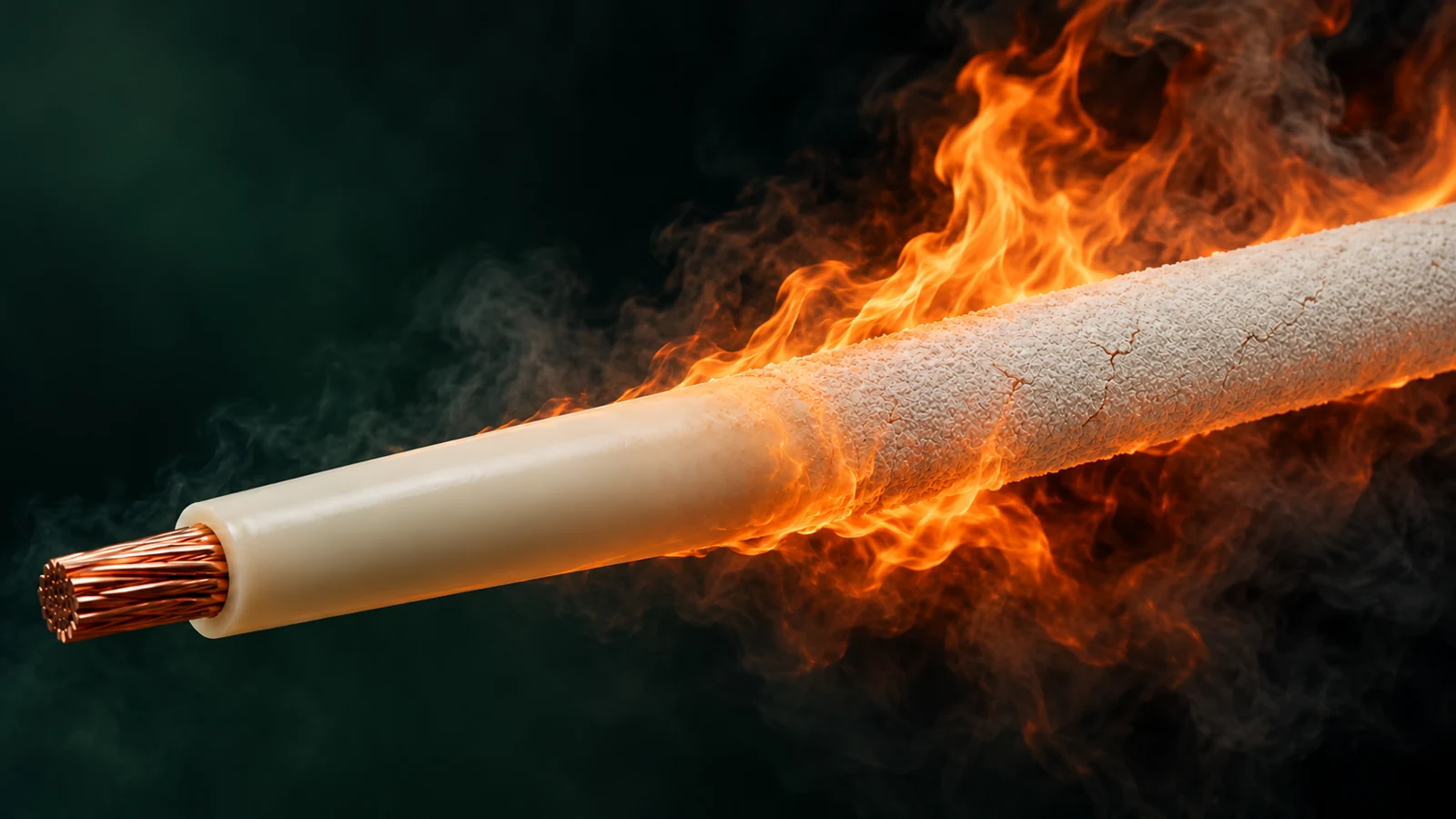
Conceptual visualization of insulation forming a ceramic-like barrier under fire exposure.
Nova Polymer’s ceramifiable cable compounds are available as a family of three grades for manufacturers looking to simplify fire alarm cable production. The family brings ceramic-forming functionality into an extrudable insulation material, with separate options for thermoplastic use, Sioplas crosslinking and electron-beam crosslinking.
The objective is to replace the separate mica tape barrier and silicone rubber insulation used in selected conventional designs with an insulation layer that can be applied on standard cable extrusion equipment. This gives manufacturers a route to higher extrusion productivity and a more competitive manufacturing cost, while working toward defined fire-performance requirements.
Why reconsider conventional insulation systems
Mica tape provides an established barrier in many fire-resistant cable constructions, but wrapping adds its own production demands. Tape tension, overlap, conductor coverage and handling must remain consistent. The taping operation can become a line-speed bottleneck and adds material, labour and process-control costs before subsequent cable operations begin.
Silicone rubber offers another established approach. Its use may require dedicated processing and curing equipment, together with additional investment and material costs. Depending on the formulation and cable design, tear strength, abrasion resistance and handling durability can also require attention. The practical comparison is therefore the performance and cost of the complete manufacturing route.
How ceramifiable insulation works
Ceramifiable compounds combine a processable polymer matrix with an engineered inorganic system. During severe heat exposure, the polymer changes and decomposes while the inorganic components interact to form a ceramic-like residue. The formulation is designed so that the residue remains sufficiently coherent to help maintain separation around the conductor.
That transformation is central to the material concept. Flame retardancy limits aspects of burning behaviour; maintaining electrical insulation during a fire also requires a barrier that continues to function as the original polymer structure deteriorates. Residue strength, dimensional stability and electrical behaviour must therefore be evaluated together.
Direct extrusion on standard cable lines
The compounds are intended for processing on standard cable extrusion lines, without a separate mica tape wrapping stage or a dedicated silicone rubber extrusion system. Removing the wrapping operation can eliminate a production bottleneck and simplify the route from conductor to insulated core.
The family supports high-speed extrusion, with the actual operating window established for the selected grade, conductor size, insulation thickness, screw configuration, tooling and cooling capacity. Line trials should confirm surface quality, concentricity and electrical integrity at the proposed production speed.
Three grades for different manufacturing routes
The thermoplastic grade is intended for applications using the material without a subsequent crosslinking stage. Processing conditions and cable construction must control deformation and support the intended ceramic-forming behaviour under fire exposure.
The Sioplas grade is designed for a silane crosslinking route, using the appropriate catalyst system and moisture-curing conditions after extrusion. The manufacturing plan must include storage and moisture control, scorch prevention and verification of the required cure level.
The E-beam grade is intended for electron-beam crosslinking after extrusion. Irradiation dose, penetration, cable geometry and the resulting material properties must be matched to the application. Irradiation requires access to a suitable facility, either in-house or through a service provider.
A route to lower manufacturing cost
The economic opportunity comes from simplifying the cable structure and production sequence. Replacing mica tape wrapping can reduce tape consumption, intermediate handling and the number of process variables. An alternative to silicone rubber insulation can also reduce dependence on dedicated silicone processing equipment.
The commercial aim is a lower total manufacturing cost than the corresponding mica tape or silicone rubber route. The comparison should include compound consumption per metre, extrusion output, scrap, equipment utilisation and any curing or irradiation costs. Actual savings depend on production conditions and should be assessed against an equivalent qualified cable design.
Insulation integrity standards and duration targets
The compound family targets insulation integrity under the specified DIN VDE 0472-814 test conditions, including FE180, and EN 50200 classes PH30–PH120. FE30, FE60, FE90, FE120 and FE180 express specified duration targets of 30, 60, 90, 120 and 180 minutes. Agree the exact FE designation and duration against the selected test method. EN 50200 PH classes include mechanical shock and are distinct from FE duration designations.
Final cable performance must be tested by the customer under actual application conditions. The appropriate test programme may also address IEC 60331-1 / -2, legacy IEC 60331-11 / -21 specifications, BS 6387 C / W / Z, DIN 4102-12 or UL 2196, where relevant to the intended cable and installation. The standards matrix defines the qualification scope for the selected cable or installation.
Selecting the right grade
Grade selection starts with the intended fire alarm cable design and the available manufacturing route. Electrical insulation properties, mechanical durability, process stability and residue integrity should be assessed alongside the target fire performance. Where low smoke, halogen-free or other fire-reaction properties are required, those characteristics also need their own supporting test results.
Discuss your conductor size, insulation thickness, extrusion equipment and target cable rating with Nova Polymer to identify the appropriate thermoplastic, Sioplas or E-beam grade and define a qualification plan for your application.
Fire performance standards
The table separates each standard or test reference from its associated duration or test designation. FE, PH and E refer to different assessments and are not interchangeable.
| Standard or test reference | Duration or test designation | Scope and validation |
|---|---|---|
| DIN VDE 0472-814 | FE30 / FE60 / FE90 / FE120 / FE180 30 / 60 / 90 / 120 / 180 minutes | Fire-exposure insulation integrity. The listed FE designations are requested duration targets, not a standalone standard or a claim that every edition defines this exact class series. Agree the designation, method, duration and acceptance criteria in the project specification. |
| EN 50200 | PH30–PH120 including PH120 | Fire resistance with mechanical shock for applicable small cables used in emergency circuits. Select the required PH class and qualify the finished cable. |
| IEC 60331-1 / -2 | Specified fire-with-shock test duration | Circuit integrity under fire and mechanical shock. Part 1 covers overall diameters >20 mm; Part 2 covers ≤20 mm. Select the applicable voltage scope and duration. |
| IEC 60331-11 / -21 | Legacy fire-alone test references including 180-minute project specifications | Fire-alone apparatus and test requirements historically associated with FE180 specifications. Both IEC publications were withdrawn on 31 December 2024. Use only as explicitly agreed legacy references. |
| BS 6387 | C / W / Z | Separate circuit-integrity tests: C for fire alone; W for fire with water; Z for fire with mechanical shock. Demonstrate each required category on the applicable cable construction. |
| DIN 4102-12 | E30 / E60 / E90 30 / 60 / 90 minutes | Functional integrity of the installed cable system under fire conditions. Qualify the cable with its specified supports and fixings for the required system rating. |
| UL 2196 | Specified hourly system rating | Fire-resistive cable or cable-system evaluation, including applicable fire and hose-stream conditions. Confirm the installation configuration and required rating. UL certification or listing is not implied. |
Final cable performance must be tested by the customer under actual application conditions. Where a standard evaluates an installed system, qualification must also cover the specified supports, fixings, raceways and other relevant components. Certification and listing claims require the corresponding approval records.
Representative fire and shock test setup
The following concept visualization shows the main elements of an EN 50200 fire and mechanical shock test: a cable specimen fixed to a non-combustible test wall, a horizontal ribbon burner, an impact mechanism and an electrical continuity monitoring arrangement.
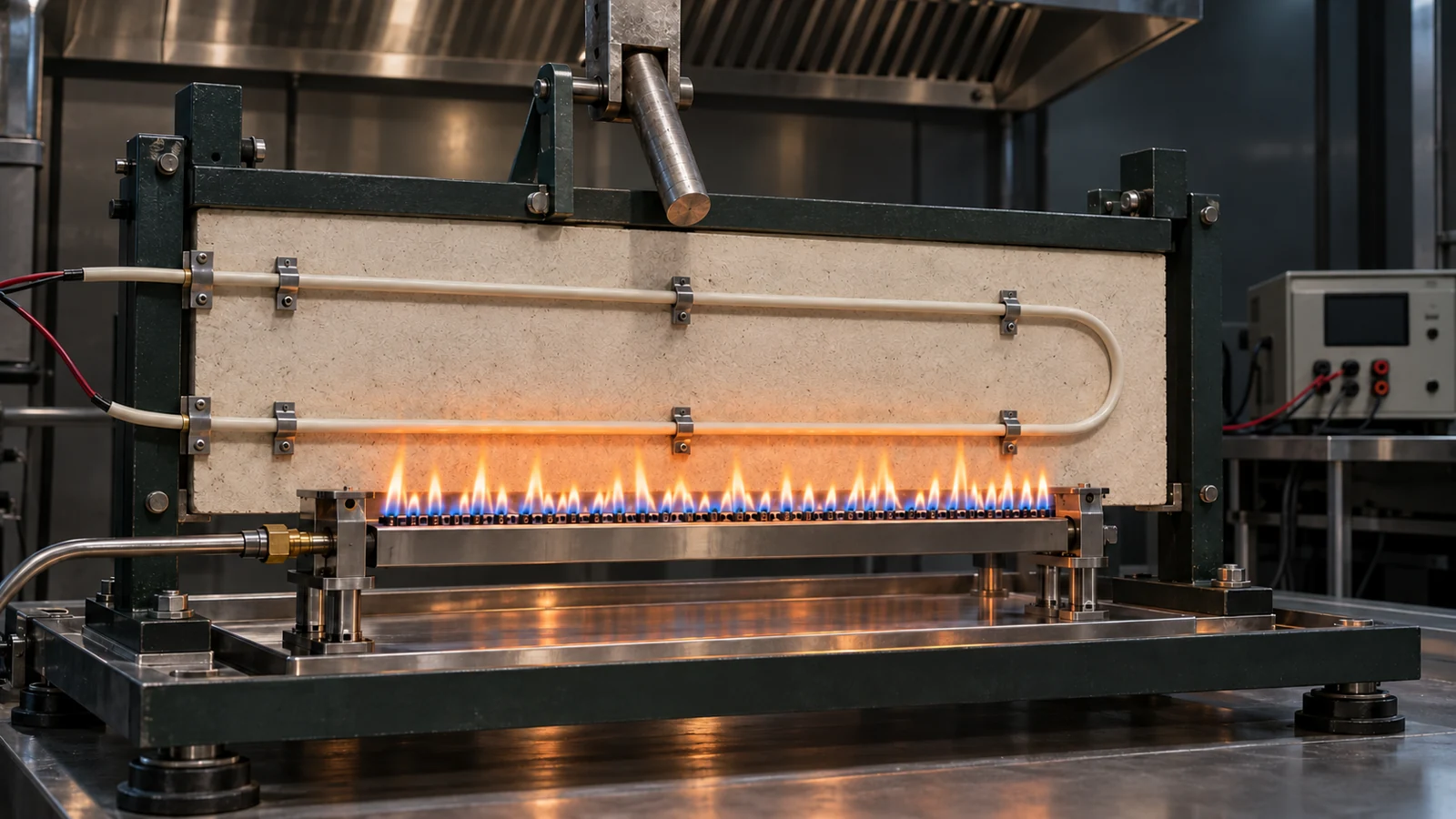
The mounted cable is exposed to a controlled flame while impacts are transmitted through the test-wall support. The electrical monitoring arrangement checks circuit continuity during the specified exposure. Cable mounting, specimen geometry, equipment verification and acceptance criteria must follow the applicable standard and the agreed test programme.
The illustration shows the fire-and-shock principle only. It does not depict the optional EN 50200 water protocol, a BS 6387 W test, a DIN 4102-12 installed-system test or a UL 2196 system evaluation. These require their own specified arrangements.